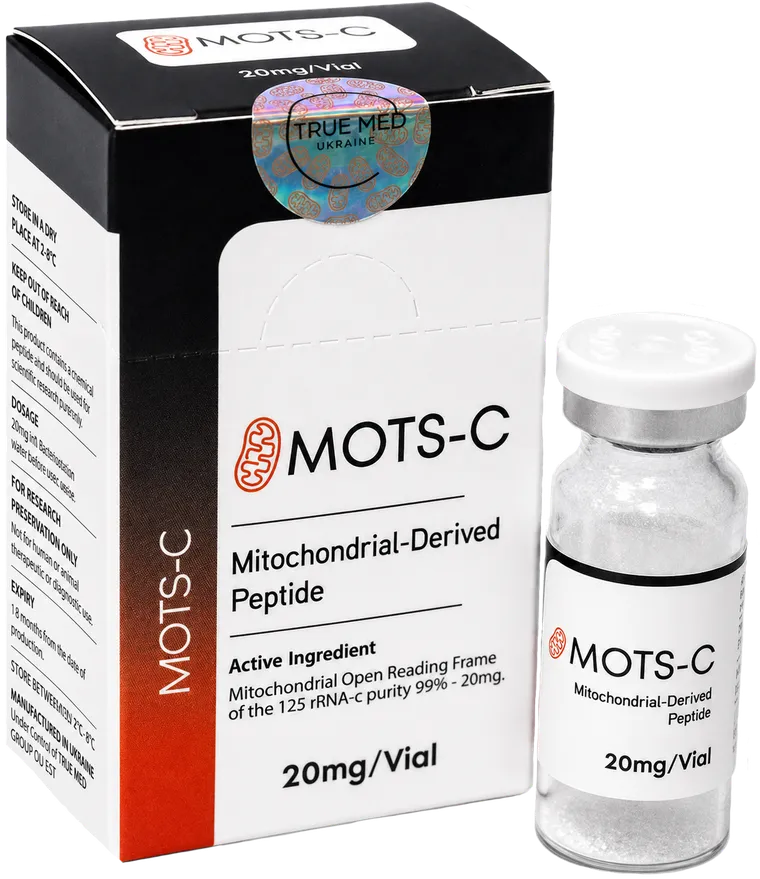
MOTS-cMitochondrial-Derived Peptide · 20 mg
Mitochondrial-derived peptide (MOTS-c) for cellular energy, metabolic activity and body composition support
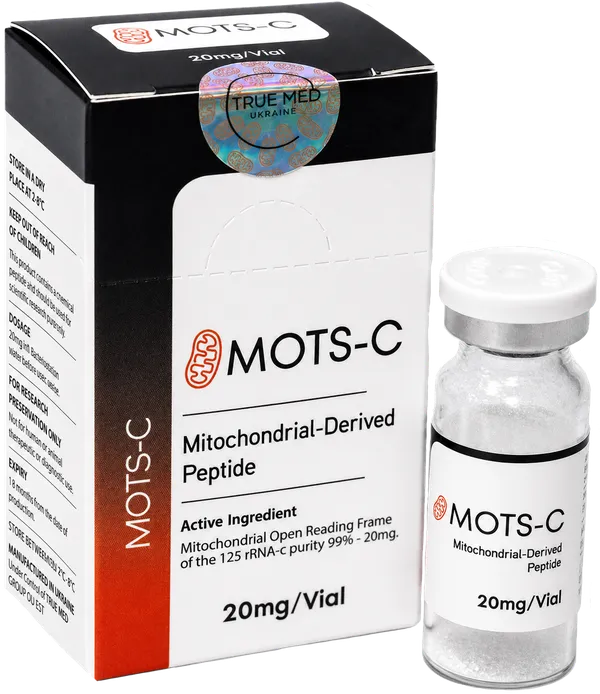
What is MOTS-C?
A peptide encoded by mitochondrial DNA (Mitochondrial Open Reading Frame of the 12S rRNA-c). A natural regulator of cellular energy that physiologically declines with age.
- Mitochondrial peptide — a natural regulator of cellular energy
- AMPK pathway activation — the same mechanism as physical exercise
- Metabolic flexibility — switching between glucose and fatty acids
- Supports glucose uptake and insulin sensitivity
Three pillars of metabolism
AMPK Pathway Activation
Triggers a key cellular energy regulator — the same mechanism activated during physical exercise.
Metabolic Flexibility
Improves the ability of tissues to efficiently switch between glucose and fatty acids as energy sources.
Insulin Sensitivity
Supports tissue glucose uptake, reducing metabolic strain.
Key effects
Expected course dynamics — cumulative effect, stabilization after completion
How MOTS-c
- AMPK pathway activation — the cell's key energy regulator
- Improved tissue metabolic flexibility
- Switching between glucose and fatty acids as energy sources
- Support of glucose uptake and insulin sensitivity
- Reduced metabolic strain on tissues
- Cumulative effect — metabolic stabilization after the course
Indications & Application Protocols
What are the indications?
- Reduced energy levels and physical endurance
- Slowed metabolism, difficulty with weight loss
- Support for weight-loss and tirzepatide programs
- Reduced tissue insulin sensitivity
- Prolonged recovery after physical exertion
- Age-related decline in metabolic activity
- Body composition support during caloric deficit
- Prevention of metabolic changes in patients 30+
How to reconstitute?
Reconstitute the 20 mg vial with 2 mL of bacteriostatic water — solution concentration 10 mg/mL. Base starting dose — 2.5 mg, with an option to increase to 5 mg when clinically indicated.
- Let the MOTS-c 20 mg vial reach room temperature
- Slowly add 2 mL of bacteriostatic water along the vial wall
- Gently swirl the vial until fully dissolved — do not shake
- Store refrigerated (+2…+8 °C), use within 20–30 days
Draw with a U-100 insulin syringe. 2.5 mg = 0.25 mL (25 units), 5 mg = 0.5 mL (50 units). One 20 mg vial provides 8 injections of 2.5 mg or 4 injections of 5 mg. Administer subcutaneously, rotating injection sites.
What are the injection protocols?
Base starting dose — 2.5 mg, with an option to increase to 5 mg when clinically indicated and well tolerated.
- Protocol 1 · Starting — 2.5 mg (0.25 mL, 25 units), once every 5 days, 8 injections per vial, 5–6 week course. Base starting scheme for most patients.
- Protocol 2 · Moderate — 2.5 mg twice a week (5 mg weekly total), 0.25 mL per injection, 8 injections per vial, 4 week course. The split dose reduces the per-injection load.
- Protocol 3 · Intensive — 5 mg (0.5 mL, 50 units), once every 5 days, 4 injections per vial, ~3 week course. For patients with confirmed good tolerance.
Titration: begin therapy at 2.5 mg (Protocol 1 or 2). Move to Protocol 3 at 5 mg — in the absence of adverse reactions after 2–3 injections and at the physician's discretion. Administer subcutaneously into the abdomen or thigh, preferably in the first half of the day.
When to expect results?
Initial subjective energy changes are typically noted after 2–3 weeks of use, with metabolic effect stabilization after completing the full course. The effect is cumulative.
Request MOTS-c
Leave your details — a manager will contact you about terms, availability and partnership.
For professional use only, under the supervision of a qualified specialist. This information is not a public offer or a substitute for medical advice.
Request product
International ecosystem and scientific environment worldwide












Representations
Sportyvna Square, 1a, Kyiv, 01023
International representations:
80 Sand Island Access Road Unit 238, Honolulu HI USA 96819
105 Yanghwa-ro, Mapo-Gu, Seoul, South Korea
Contact us
Phone: +380 (99) 811 68 37
truemed.ukraine@gmail.com


